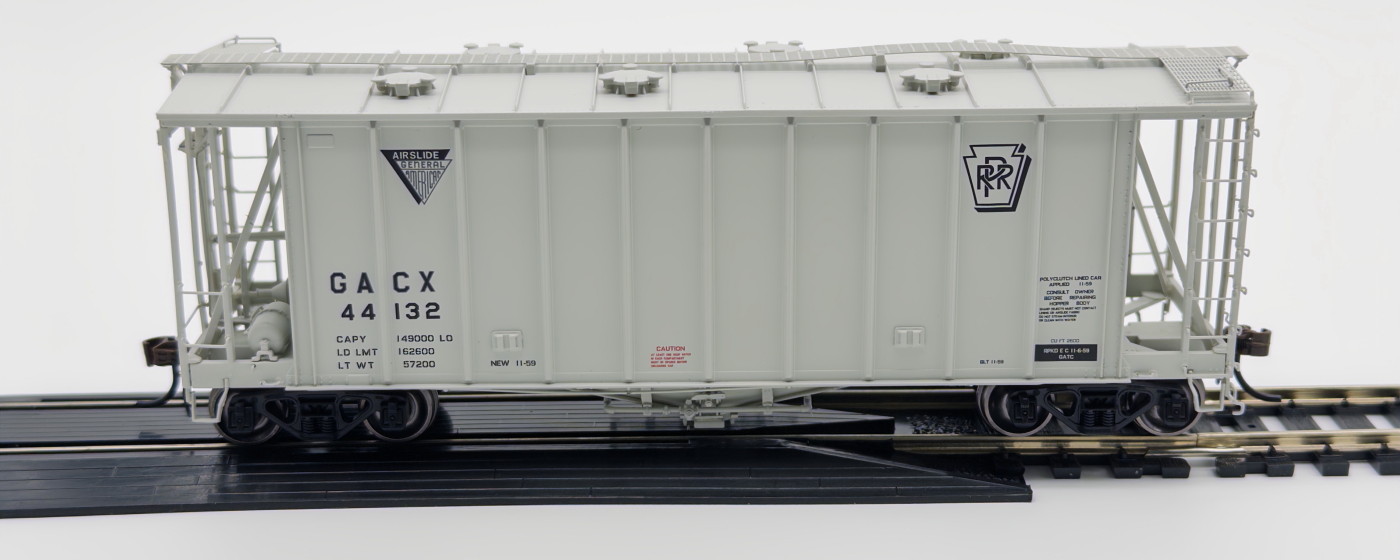
Hopper - Covered
PRR #44132
40' Hopper. For the first half of the 20th century, bulk goods were usually bagged and carried in boxcars. After the late 1940s, covered hoppers greatly simplified the process by allowing the bulk material to be poured in through the roof hatches and dumped out the hopper bays. However, flour, starch, sugar and plastics do not “flow” easily from a standard hopper bay. To solve this problem, the Fuller Company of Catasauqua, PA, patented the Airslide concept. In an Airslide covered hopper, the bays are formed into two narrow, steep-sided troughs with a layer of air-permeable material at the bottom. Air is pumped through the material causing the lading to fluidize and flow easily through the hopper outlets. Starting in 1953, General American Transportation Corporation (GATC) began building Airslide covered hoppers. One of the two original configurations was a 2,600-cubic foot, single-bay car with a 70-ton capacity. In addition to railroad-owned cars, there were several Airslide covered hoppers leased by GATC to sugar and bakery companies. Later, larger cars were introduced as the railroads continued to improve their infrastructure. To extend the useful lives of the smaller 2600 cubic ft cars, some of them were permanently connected in 2-unit drawbar sets. The drawbar sets operated as a single car, and therefore had a whopping total capacity of 5200 cubic ft - although their substantial length was a notable drawback. The Pennsylvania Railroad leased this type of car, featuring the standard GACX reporting mark with the PRR Keystone logo, for its bulk commodity service.