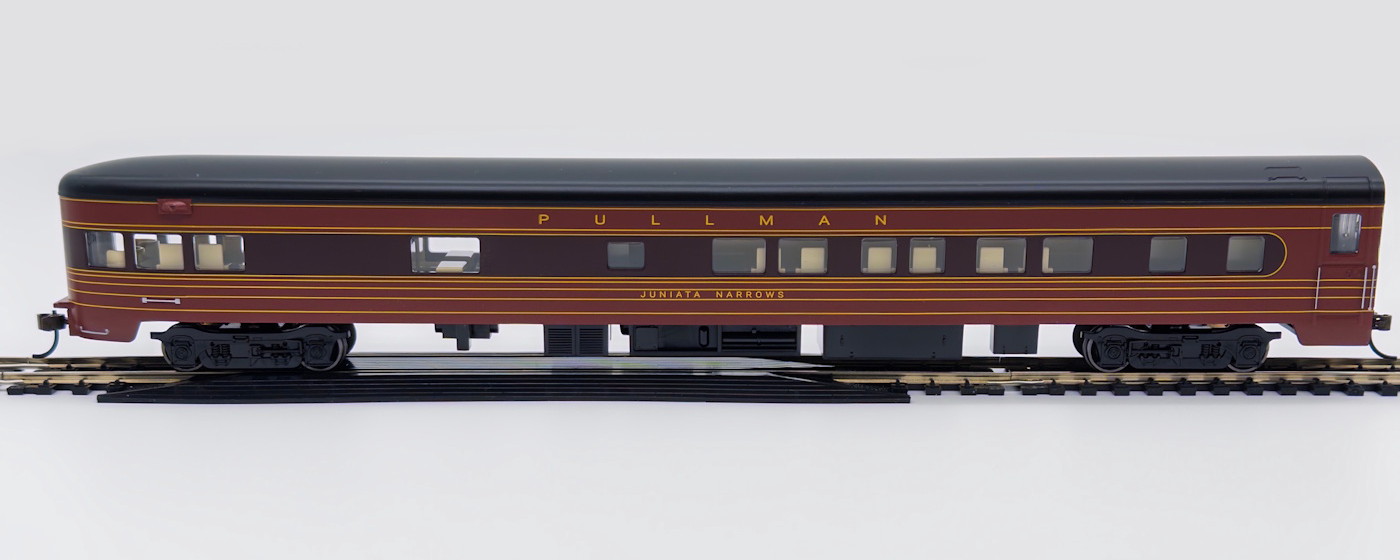
Passenger - Observation Car
PRR #8111
The "Juniata Narrows" - 85' Smooth-Side Observation Car. The streamlined observation car was an evolution of the open-ended observation platforms found at the end of long-distance heavyweight consists. Fully enclosed, the car curved to a point, offering a full 180-degree view of the track behind, with a rear door or window, and space for a drumhead to advertise the service below. In the 1930s, lighter-weight materials allowed for the development of a variety of coach, baggage, and observation cars as railroads ushered in the beginning of the streamlined era. Materials like stainless steel, and aluminum, allowed for passenger cars to have smooth sides, and their lightweight construction proved valuable in reducing travel times on express services. A bit more background - The Pennsylvania Railroad’s (PRR) Juniata Narrows was part of the scenic, challenging Juniata River valley route between Harrisburg and Pittsburgh. This route was crucial for handling heavy freight and passenger traffic. It required significant engineering to widen, often lifting tracks above grade, and was famously linked with other river gap observation points like Jack’s and Lewistown Narrows. Situated along the Juniata River, this area was a key geological hurdle on the PRR main line traversing the ridge-and-valley section toward the Allegheny Front. The route required major widening projects over time to accommodate traffic growth, with some improvements lifting the track bed above its original grade. The PRR identified specific, narrow river gaps with "Narrows" suffixes, notably Jack's Narrows, Juniata Narrows, and Lewistown Narrows. These narrows were part of the vital 1846-chartered route that connected Philadelphia/Harrisburg to Pittsburgh, forming the backbone of the PRR.