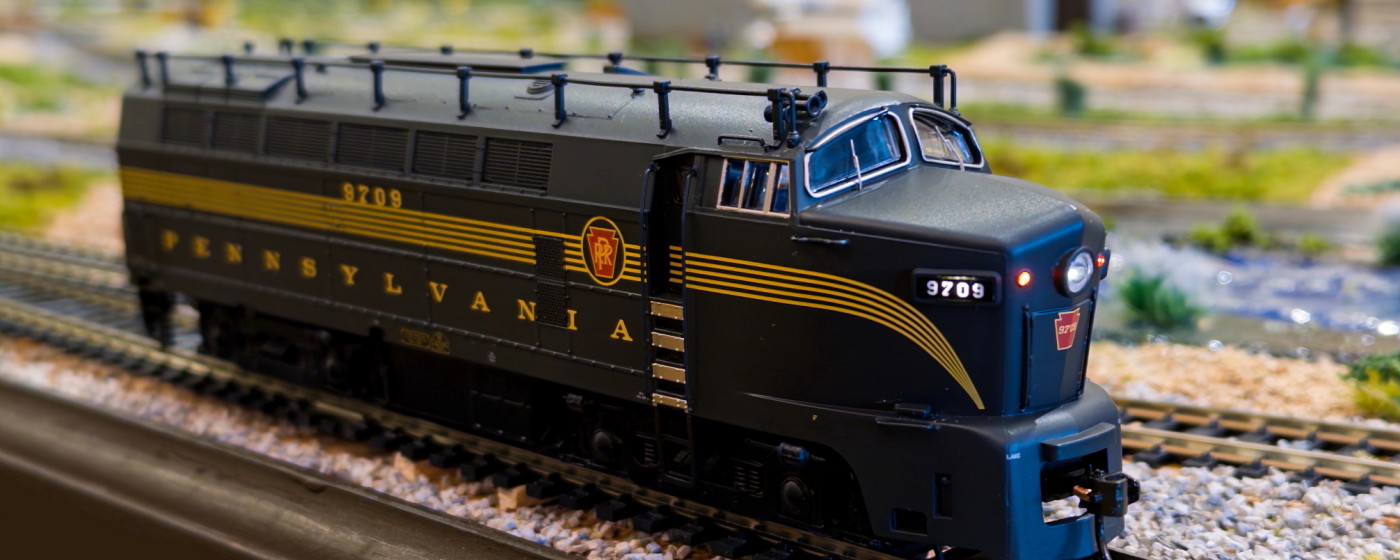
Engine
PRR #9709
The Pennsylvania Railroad was the largest single owner of RF-16s. In 1948, Baldwin began to apply a new "Sharknose" body style to its cab unit diesel locomotives. The goal of the new style was partly to differentiate Baldwin locomotives from competitors, and partly to distance the new locomotives from early Baldwin diesels that were plagued with mechanical problems. The style was inspired by the Pennsylvania Railroad's T1 class duplex steam locomotives, some of which were built by Baldwin. The BLH RF-16 is a 1,625-horsepower (1,212 kW) cab unit-type diesel locomotive built for freight service by the Baldwin-Lima-Hamilton Corporation between 1950 and 1953. All RF-16s were configured with a B-B wheel arrangement and ran on two AAR Type B two-axle road trucks, with all axles powered. A total of 109 cab-equipped A units were built, along with 51 cabless booster B units, for a total of 160 locomotives built. Like most contemporary passenger locomotives, the RF-16s came equipped with a retractable, nose-mounted drop coupler pilot. The classification system for the RF16 was very straightforward, "RF" referred to Road Freight, "16" designated the horsepower rating of 1,600. Overall the RF16 sold fairly well although only three Class I railroads ultimately purchased it: Baltimore & Ohio, New York Central and the Pennsylvania Railroad or PRR (Baldwin's ever-loyal customer).