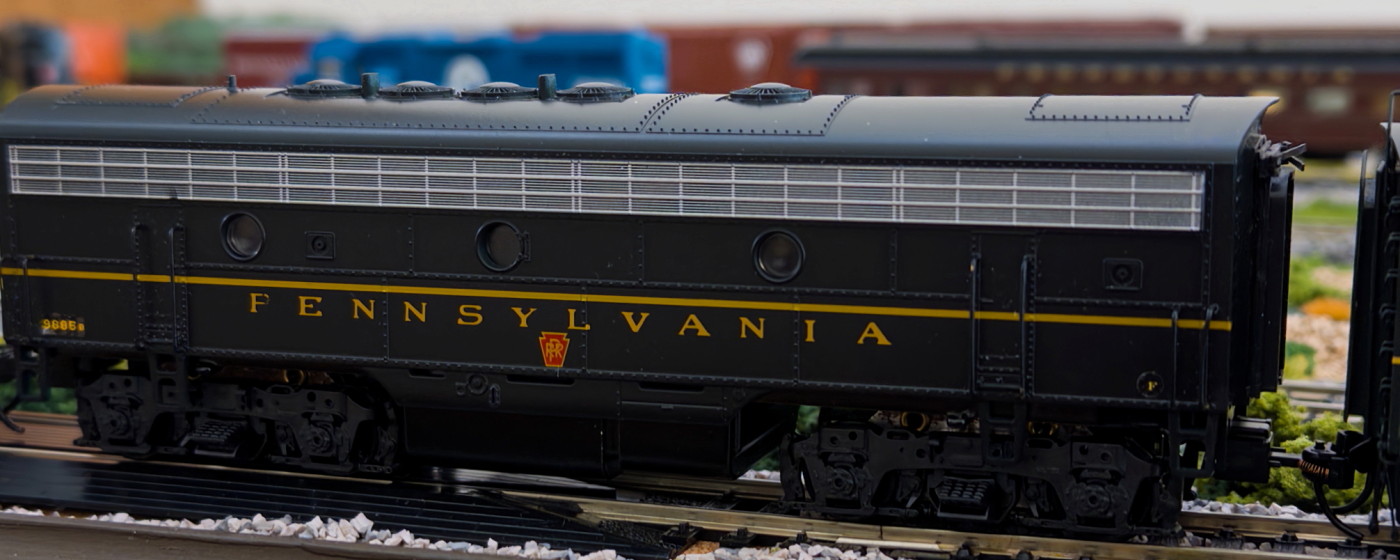
Engine
PRR #9885B
The "B" designation indicates a "booster" unit, which is a locomotive body without an operator's cab, designed to be run in tandem with a "cab" or "A" unit (like the FP7 or F7A models). These units were rated at 1,500 horsepower and used for both fast freight and passenger services. This particular unit's paint scheme is Brunswick Green Enamel with a single Gold Stripe. Produced between February 1949 and December 1953 by the Electro-Motive Division of General Motors (EMD) and General Motors Diesel (GMD). Many F7s remained in service for decades, as railroads found them economical to operate and maintain. However, the locomotive was not very popular with yard crews who operated them in switching service because they were difficult to mount and dismount, and it was also nearly impossible for the engineer to see hand signals from a ground crew without leaning way outside the window. As most of these engines were bought and operated before two-way radio became standard on most American railroads, this was a major point of contention. In later years, with the advent of the "road switchers" such as the EMD GP7, F-units were primarily used in "through freight" and "unit train" service where there was little or no switching to be done.